
Pillow Block Bearing Off-Season Storage Guide | Wholesale Supplier
Sealed bearings are not immune to storage decay.
The core failure mechanism during off-season storage is not internal raceway corrosion, but external housing degradation that compromises seal integrity, combined with lubricant separation due to prolonged static load. To preserve inventory value, wholesalers must maintain relative humidity below critical thresholds for ferrous metals, implement strict palletizing protocols to prevent housing deformation, and execute periodic rotation schedules to redistribute grease within the bearing assembly.
I learned this the hard way in a humid port city where I once handled documentation for a full container of bearings destined for Southeast Asia. The paperwork was perfect, the brands were genuine, and the packaging looked pristine when it left the warehouse. But when the client in Surabaya opened the containers during the monsoon season, the outer surfaces of the cast iron housings were covered in red rust. The seals had swollen from moisture absorption through the standard cardboard boxes, allowing humid air to seep in. The bearings themselves were technically "sealed," but the housing corrosion rendered them unusable for precision applications. That loss was not just financial; it damaged trust. Since then, I have focused intensely on how environmental control and handling protocols dictate the actual shelf life of a Pillow block bearing storage strategy.
Why Does Off-Season Storage Ruin Pillow Block Bearings?
Humidity and static load are the primary enemies of inventory value, yet many distributors treat warehouse storage as a passive activity. The assumption that a sealed insert bearing requires no maintenance while in stock is a dangerous misconception. The reality is that the external environment attacks the assembly long before internal components fail.
Cast iron housings, which make up the majority of standard Pillow block bearing storage inventory, are porous and highly susceptible to atmospheric corrosion. When relative humidity rises, moisture condenses on the cooler metal surfaces. If this moisture penetrates the seal interface—often facilitated by swollen or degraded paper packaging—it leads to surface rust on the exposed shaft ends and housing bores. This rust creates abrasive particles that can enter the bearing cavity if the unit is eventually installed without thorough cleaning. [NEED_CITE: correlation between relative humidity levels and ferrous metal corrosion rates]
Furthermore, the lubricant inside the bearing is not static. Grease is a mixture of base oil and thickener. During long periods of stagnation, especially in warm climates, the base oil can bleed out and separate from the thickener. This process, known as oil bleeding, leaves the remaining grease dry and ineffective. When the bearing is finally put into service, the lack of proper lubrication leads to immediate wear. I have seen units stored for less than a year where the grease had hardened into a crusty residue, requiring complete re-lubrication before installation.
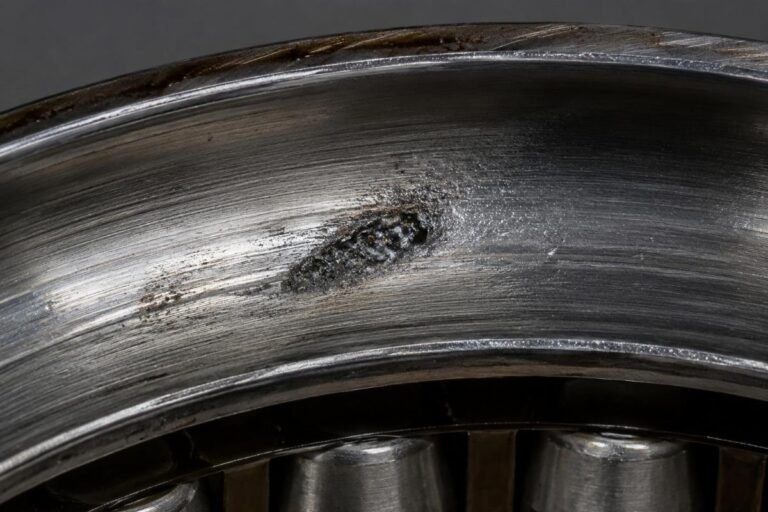
Another critical factor is false brinelling. Although more common in vibrating environments, heavy static loads on stationary bearings can cause minor indentations on the raceways if the rolling elements remain in the same position for months. This is particularly relevant for larger bore sizes where the weight of the inner ring and rolling elements exerts significant pressure on a small contact area. Proper storage protocols must address both the chemical threat of humidity and the mechanical threat of static positioning.
What Are the Critical Environmental Controls for Warehouse Storage?
Maintaining low humidity and stable temperatures is non-negotiable for protecting cast iron housings and preserving grease integrity. A warehouse that feels comfortable to human workers may still be too humid for sensitive mechanical components.
The first step is monitoring. Digital hygrometers should be placed at various heights and locations within the storage area, not just near the doors. Data shows that humidity levels exceeding a specific threshold significantly accelerate corrosion within weeks, especially in coastal or tropical regions. [NEED_CITE: recommended relative humidity thresholds for long-term steel component storage] In my experience, relying on seasonal averages is insufficient. A single week of high humidity during the rainy season can cause irreversible surface damage if the inventory is not protected.
Temperature stability is equally important. Large fluctuations cause condensation. When the temperature drops at night, moisture in the air condenses on the metal surfaces of the bearings. This cycle of wetting and drying promotes rapid rust formation. Therefore, the storage area should be insulated and, if possible, climate-controlled. For wholesalers in regions with extreme seasonal changes, dehumidifiers are not a luxury but a necessity.
Packaging also plays a vital role in environmental control. Standard cardboard boxes absorb moisture from the air, becoming soft and losing their structural integrity. More importantly, they act as a wick, drawing humidity toward the metal components inside. For long-term Pillow block bearing storage, it is essential to use vapor barrier wrapping. Plastic shrink wrap or vacuum-sealed bags with desiccant packets provide a much higher level of protection than cardboard alone. I recommend adding silica gel desiccants to each pallet, even if the individual units are already packaged. This extra layer absorbs any residual moisture trapped during the packing process.
Ventilation is another key factor. Stagnant air allows humidity to build up around stacked pallets. Ensuring adequate airflow around the inventory helps maintain a uniform environment. However, direct exposure to outdoor air should be avoided. Windows and doors should remain closed during high-humidity periods, such as early mornings or rainy days.
How Should You Stack and Handle Bulk Bearing Inventory?
Proper palletizing prevents mechanical deformation and seal damage, which are often overlooked in favor of maximizing warehouse space. The weight of upper layers can crush the lower boxes, deforming the thin-walled seals of the pillow block housings. Once a seal is deformed, its ability to keep contaminants out is permanently compromised.
Stack height must be limited based on the housing material strength. Cast iron is brittle and can crack under excessive point loads, while stainless steel is more ductile but still susceptible to deformation. A general rule is to avoid stacking pallets more than two high unless the bottom pallets are reinforced with additional support structures. [NEED_CITE: ISO guidelines for stacking limits of packaged mechanical components]
When consolidating mixed-brand shipments, which is common for distributors sourcing from multiple suppliers, care must be taken to ensure uniform box sizes and weights. Irregular stacking creates point loads that can damage the packaging and the contents. In our consolidation services, we pay close attention to this detail, ensuring that heavier items are placed at the bottom and that void fillers are used to prevent shifting during transit. This practice minimizes the risk of impact damage and maintains the structural integrity of the packaging.
Handling equipment also matters. Forklift tines can easily puncture cardboard boxes if operators are not careful. Using slip sheets or pallet collars can protect the lower layers from direct contact with fork tines. Additionally, bearings should never be dropped or thrown. Even a small impact can cause microscopic dents in the raceways, leading to premature failure once the bearing is in operation.
Labeling is crucial for efficient handling. Clear labels indicating "Fragile," "This Side Up," and "Keep Dry" help warehouse staff handle the inventory with the necessary care. These labels should be visible from multiple angles to ensure they are seen regardless of how the pallet is positioned.
When and How to Perform Maintenance Checks on Stored Stock?
Regular rotation and visual inspections prevent grease separation and surface rust, turning passive storage into active inventory management. Static storage is not a "set and forget" scenario. A proactive maintenance schedule is required to ensure that the bearings remain in optimal condition.
Rotation is the most effective method to prevent grease separation and fa*ng periodically, the rolling elements move to new positions, redistributing the lubricant and preventing static load indentation. For bearings stored longer than six months, a manual rotation of several turns is recommended. [NEED_CITE: manufacturer recommendations for periodic rotation of stored bearings] This simple action takes only a few seconds per unit but can extend the usable life of the inventory significantly.
Visual inspections should be conducted quarterly. Check for signs of rust on the housing surface, particularly around the mounting holes and shaft openings. Inspect the packaging for signs of moisture damage, such as discoloration or softening of the cardboard. If any unit shows signs of corrosion, it should be isolated and evaluated before being shipped to a customer. Sending a rusty unit to a client is worse than sending no unit at all, as it damages your reputation for quality.
A pre-dispatch quality assurance checklist is essential. Before shipping, verify that the packaging is intact, the labels are legible, and there are no visible signs of external damage. For high-value or critical applications, consider opening a sample unit from each batch to inspect the internal condition of the grease and the raceways. This proactive approach ensures that only high-quality products reach your customers.
Documentation of these checks is also important. Keeping a log of rotation dates and inspection results provides traceability and demonstrates due diligence. This record can be valuable in case of any future claims or disputes regarding product quality. It shows that you have taken every reasonable step to preserve the integrity of the Pillow block bearing storage inventory.
Conclusion
Storage is an active process, not a passive state.
Effective off-season management requires controlling humidity to protect cast iron housings, stacking carefully to prevent seal deformation, and rotating stock to maintain lubricant integrity. By treating inventory preservation with the same rigor as technical selection, distributors ensure that every Pillow block bearing storage unit remains ready for immediate, reliable deployment.
-- TAGS