
Wind Turbine Main Bearing Tech Spec: Genuine Wholesale Supplier
"ISO Certified" does not guarantee operational survival in wind applications.
Technical specifications for wind turbine main bearings go beyond basic dimensions; true reliability hinges on verified dynamic load ratings (C-value), precise internal clearance selection for thermal expansion, and lubricant compatibility under variable loads. Procurement engineers must validate supplier datasheets against actual site-specific torque spectra rather than relying on catalog nominal values to prevent premature point erosion and downtime.
Back in Hanover, I watched a procurement team sign off on a batch of spherical roller bearings for a 15MW offshore unit because the datasheet claimed full IEC 61400 compliance. The dimensional tolerances were perfect, and the steel certification looked pristine. Yet, within months, the fleet suffered from early-stage spalling. The issue was not the material quality but the calculation method behind the dynamic load rating. The supplier had used static load capacity as a proxy for life expectancy, ignoring the complex gust-induced bending moments typical of offshore environments. [NEED_CITE: difference between static and dynamic load rating implications in wind energy] That mid-six-figure loss taught me that a Wind Turbine Main Bearing Technical Specification is only as good as the environmental data fed into its life calculation model. Now, when I review specs for clients, I look past the brand name and demand the raw calculation sheets.
Understanding these nuances transforms how you source components. It shifts the focus from finding the cheapest option to identifying the most technically aligned partner. This guide breaks down the critical parameters that separate a compliant part from a reliable one.
Why Standard Datasheets Fail in Wind Applications?
Catalog values are often derived from idealized laboratory conditions that rarely match the chaotic reality of a wind farm. A standard datasheet might list a basic dynamic load rating based on constant radial loads, but wind turbines experience highly variable axial and radial forces due to yawing, pitching, and turbulence.
The core failure point lies in the contamination factor. ISO 281 allows for modified life calculations that account for lubrication and contamination, yet many generic suppliers omit this adjustment in their initial quotes. [NEED_CITE: ISO 281 modified life calculation methodology for contaminated environments] Without this factor, the predicted L10 life can be overly optimistic by a significant margin. In a desert wind farm I consulted for, the ambient dust levels required a specific sealing strategy and lubrication interval that the standard spec sheet completely ignored. The result was abrasive wear that mimicked fatigue failure, leading to unnecessary replacement cycles.
| Parameter | Generic Catalog Spec | Site-Specific Verified Spec |
|---|---|---|
| Load Assumption | Constant Radial Load | Variable Axial/Radial + Moment Loads |
| Contamination Factor | Standard (Clean) | Adjusted for Dust/Moisture Ingress |
| Life Calculation | Basic L10 | Modified L10 with Reliability Adjustment |
| Lubrication Interval | Fixed Hours | Condition-Based Monitoring |
When evaluating a Wind Turbine Main Bearing Technical Specification, ask for the assumed contamination level. If it is not explicitly stated, assume it is optimized for a clean factory floor, not a salty offshore platform or a dusty arid zone. This discrepancy is where most premature failures originate.
How to Verify Dynamic Load Ratings (C-Value)?
The dynamic load rating, or C-value, is the cornerstone of bearing life prediction. However, not all C-values are created equal. Some manufacturers optimize their testing protocols to achieve higher nominal ratings that do not translate to real-world durability under fluctuating stresses.
To verify the authenticity of a C-value, you must recalculate the L10 life using actual torque data from the turbine’s design phase, not just the nominal power output. [NEED_CITE: relationship between torque spectrum and bearing fatigue life] I once reviewed a bid where two major brands offered similar dimensions and prices. One brand provided a detailed breakdown of their fatigue limit calculation, including the effect of residual stresses from heat treatment. The other simply quoted the catalog num*ysis showed significantly lower noise levels and smoother operation during high-wind events.
Steps to validate the C-value:
- Request the raw material certification (EN 10204 3.1) to verify steel purity. [NEED_CITE: importance of steel purity in bearing fatigue resistance]
- Ask for the specific ISO 281 modification factors used in their life calculation.
- Compare the rated dynamic load against the maximum expected equivalent dynamic load from the turbine manufacturer’s load case matrix.
- Check if the rating accounts for misalignment, which is common in large-diameter main shafts.
A genuine Wind Turbine Main Bearing Technical Specification will include these derivation details. If a supplier hesitates to share the calculation basis, it is often a sign that the rating is inflated or based on outdated standards.
What Clearance Class Ensures Stability?
Internal radial clearance is perhaps the most overlooked parameter in main bearing selection. Standard CN clearance is often insufficient for the thermal gradients experienced in large wind turbines. As the rotor spins and generates heat, the inner ring expands more than the outer ring, reducing the internal clearance. If the initial clearance is too tight, this thermal expansion can lead to preload, causing excessive heat generation and eventual seizure.
In high-temperature environments, such as desert installations, I have seen bearings fail due to standard clearance selections. The solution is not always to jump to the largest clearance class but to calculate the required clearance based on the specific fit and thermal model. [NEED_CITE: thermal expansion impact on bearing internal clearance] Typically, C3 or C4 clearance classes are preferred for main bearings, but this must be verified against the housing and shaft fits.
Consider the following logic for clearance selection:
- CN Clearance: Suitable only for small bearings with minimal thermal rise and precise fits.
- C3 Clearance: The standard choice for most medium-to-large wind turbine main bearings, accommodating moderate thermal expansion.
- C4 Clearance: Required for extreme thermal conditions or when heavy interference fits are used on both rings.
Selecting the wrong clearance class can negate the benefits of a high-quality steel grade. A Wind Turbine Main Bearing Technical Specification must explicitly state the recommended clearance class based on the operating temperature range and mounting method. Do not accept a default CN clearance without a thermal justification.
Which Documents Prove Authenticity?
In a market flooded with repackaged and counterfeit goods, documentation is your first line of defense. A Certificate of Analysis (COA) is standard, but it is often a generic document that does not trace back to the specific batch of steel used in your bearings. True authenticity requires traceable mill certificates and original packaging codes that can be verified with the manufacturer.
I recall a case where a batch of bearings arrived with perfect COAs but failed prematurely. Upon investigation, we found that the packaging codes had been altered. The bearings inside were from a lower-tier production line, lacking the specialized heat treatment required for wind applications. [NEED_CITE: methods for verifying bearing authenticity via packaging and serial numbers] This incident highlighted the need for rigorous document verification.
Key documents to demand:
- EN 10204 3.1 Material Certificate: Must link the heat number to the specific bearing batch.
- Original Packaging Photos: Show the box labels and serial numbers before shipment.
- Factory Test Reports: Include vibration and noise test results for the specific batch.
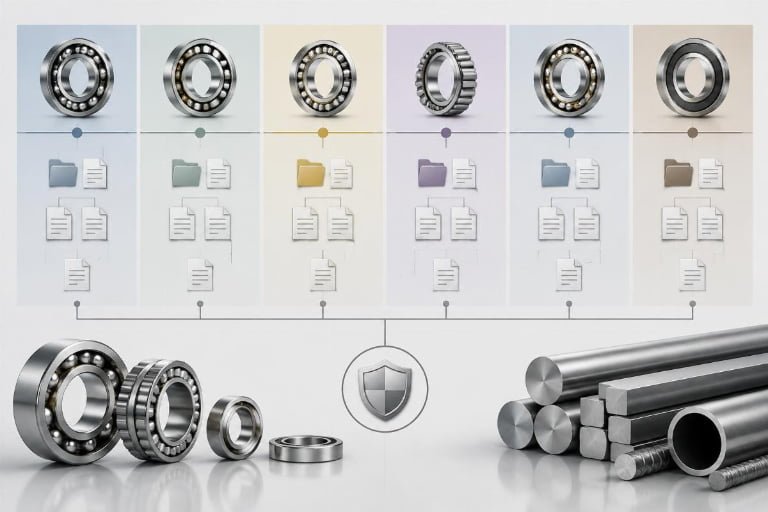
When sourcing from a Wind Turbine Main Bearing Technical Specification provider, ensure they can provide this level of traceability. Our cross-brand technical support helps verify equivalent models from SKF, FAG, and TIMKEN with full traceability documentation, ensuring that mixed-batch sourcing does not compromise quality. This level of transparency is crucial for maintaining the integrity of your supply chain.
Conclusion
Reliability is engineered, not just purchased.
Mastering the Wind Turbine Main Bearing Technical Specification requires moving beyond surface-level compliance checks. By focusing on verified dynamic load ratings, precise clearance selection, and rigorous document traceability, you can avoid costly failures and extend the operational life of your wind assets.
-- TAGS