
Electric Motor Bearing Load Ratings: Wholesale Supplier Guide
A higher dynamic load rating does not guarantee longer bearing life in electric motors.
Correctly interpreting dynamic (Cr) and static (C0) load ratings per ISO 281 is critical for predicting bearing life in electric motors, where high speeds and specific vibration loads differ from general industrial applications. Misunderstanding these values leads to premature failure, especially when axial thrust or shock loads are ignored in deep groove selections.
I still remember the silence in the warehouse after a batch of bearings returned from a water pump manufacturer in Shandong. The client had insisted on a specific light-series deep groove ball bearing, citing its impressive dynamic load rating from the catalog. On paper, it looked perfect for the radial load of the motor shaft. But within months, the pumps started screaming. When we dissected the failed units, the raceways were dotted with point corrosion, not from fatigue, but from brinelling caused by frequent start-stop shocks. The dynamic rating was irrelevant because the real killer was the static shock during startup, before the lubricant film could fully form. That incident shifted my entire approach to electric motor bearing load rating standards. I stopped looking at just one number and started asking about the environment, the startup frequency, and the hidden axial forces.
Understanding these ratings is not just about reading a datasheet; it is about matching the physical reality of the motor’s operation with the mechanical limits of the steel. For distributors and OEMs, this distinction is the difference between a reliable supply chain and a constant stream of warranty claims.
What Are Dynamic and Static Load Ratings?
Dynamic and static load ratings define two completely different failure modes, yet they are often confused in procurement specifications.
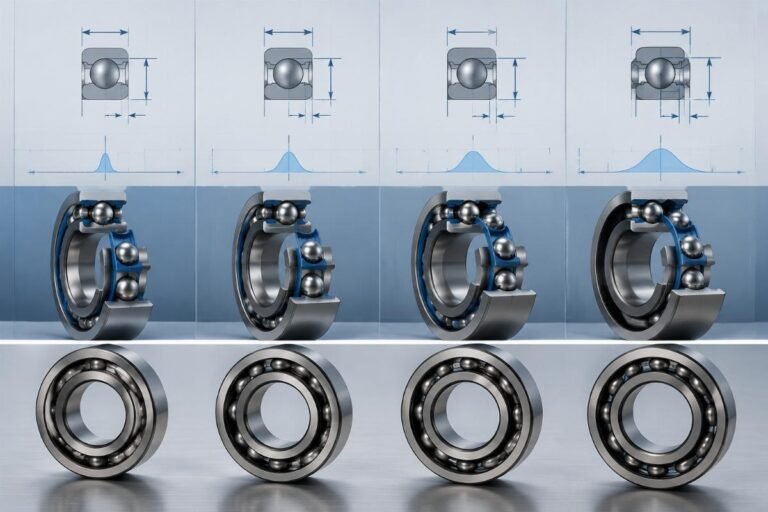
The dynamic load rating, denoted as Cr, is the constant radial load that a bearing can theoretically endure for one million revolutions with ninety percent reliability. It is the cornerstone of the L10 life calculation. However, this number assumes steady-state rotation. In contrast, the static load rating, C0, represents the load that causes a permanent deformation of approximately 0.0001 times the rolling element diameter. This is crucial for moments when the motor is stationary or moving very slowly.
Many buyers focus exclusively on Cr because electric motors are rotating machines. This is a dangerous oversight. During transport, installation, or sudden stops, the bearing experiences static loads. If the peak shock load exceeds C0, the rolling elements dent the raceway. Once dented, every subsequent rotation generates vibration and noise, accelerating fatigue regardless of how high the Cr value is. [NEED_CITE: definition of static load rating per ISO 76]
In my experience dealing with heavy-duty crusher motors, the static rating is often the limiting factor. These motors face massive inertial shocks when the crusher jams and restarts. A bearing with a high Cr but a low C0 will survive the running hours but fail during the first few shock events. Conversely, for high-speed spindle motors, the dynamic rating is paramount, but only if the speed factor is within limits. Standard grease may fail at high RPMs, causing heat buildup that negates the benefit of a high load rating.
When reviewing electric motor bearing load rating standards, always check both values. If the application involves frequent starts, stops, or heavy external shocks, prioritize C0. If the motor runs continuously at high speed with steady loads, Cr becomes the primary driver for selection. Ignoring either one creates a blind spot in your reliability prediction.
How Do Load Ratings Affect Motor Bearing Life?
The nominal L10 life calculated from dynamic load ratings is rarely the actual service life in real-world motor applications.
The basic life equation uses Cr and the equivalent dynamic load P to estimate how long a bearing will last. However, this formula assumes ideal conditions: perfect alignment, clean lubrication, and normal operating temperatures. In reality, electric motors operate in environments that deviate significantly from these ideals. The adjusted rating life method introduces modification factors for reliability, lubrication, and contamination.
One critical factor is the lubrication viscosity ratio. If the oil film is too thin due to high temperature or low viscosity, metal-to-metal contact occurs, reducing life drastically. Conversely, excessive preload from an incorrect fit can generate heat, breaking down the lubricant and shortening life even if the load rating suggests otherwise. [NEED_CITE: impact of lubrication viscosity on adjusted rating life per ISO 281]
I once consulted for a marine pump operator who kept replacing bearings every six months. The load calculations showed the bearings should last years. The issue was not the load magnitude but the direction. The deep groove ball bearings selected had a high Cr for radial loads but poor capacity for the axial thrust generated by the pump impeller. The axial component was ignored in the initial selection, leading to edge loading and premature spalling. By switching to a bearing with a higher axial load capacity and recalculating the equivalent load using the correct X and Y factors, the failure rate dropped noticeably.
For those sourcing electric motor bearing load rating standards, it is essential to understand that Cr is a baseline, not a guarantee. Real life depends on how well the bearing is supported by proper lubrication, fitting, and alignment. Without these, even the highest rated bearing will fail prematurely.
Why Standard Ratings Fail in High-Vibration Environments?
Standard load ratings assume smooth operation, but many industrial motors face severe vibration and shock loads that invalidate basic calculations.
In mining and construction equipment, motors are subjected to constant vibration from the machinery they drive. This vibration adds dynamic components to the load that are difficult to quantify but easy to feel. Standard Cr values do not account for these high-frequency oscillations, which can cause fretting corrosion and micro-movement between the bearing and the housing.
Moreover, shock loads from sudden stops or impacts can exceed the static load rating C0 instantly. When this happens, the bearing suffers permanent damage before it even begins its operational life. This is common in crusher and conveyor applications where the motor must handle sudden jams or heavy material drops.
A case from a cement plant in Africa illustrates this well. The motor bearings were failing repeatedly despite being sized correctly for the continuous load. The root cause was the shock load during startup when the mill was partially loaded. The instantaneous peak load exceeded the C0 rating, causing brinelling. By selecting a bearing with a higher static load rating and implementing a soft-start controller, the failures ceased. [NEED_CITE: effect of shock loads on bearing life in heavy industry]
When applying electric motor bearing load rating standards in high-vibration environments, it is crucial to add a safety margin to the static load rating. Do not rely solely on the dynamic rating for life prediction. Consider the worst-case shock scenarios and ensure the bearing can withstand them without permanent deformation.
How to Select the Right Bearing Based on Load Data?
Selecting the right bearing requires a step-by-step analysis of load type, magnitude, and direction, rather than just matching shaft diameter.
First, determine the nature of the load. Is it purely radial, purely axial, or combined? Deep groove ball bearings handle moderate axial loads, but angular contact or cylindrical roller bearings may be needed for higher axial or radial demands respectively. Use the X and Y factors from the manufacturer’s catalog to calculate the equivalent dynamic load P for combined loading scenarios.
Second, assess the speed and temperature. High speeds require bearings with lower friction and better heat dissipation. Check the speed limit of the bearing and ensure the lubrication is suitable for the operating temperature. If the temperature rises, the viscosity of the lubricant drops, reducing the film thickness and increasing wear.
Third, evaluate the environmental conditions. Dust, moisture, and corrosive agents can degrade the bearing quickly. In such cases, seals and shields are necessary, but they also affect the load capacity and speed limit. Choose a sealing solution that balances protection with performance.
Finally, verify the fit and clearance. An incorrect fit can lead to excessive preload or looseness, both of which reduce bearing life. Ensure the housing and shaft tolerances match the bearing’s requirements. For electric motors, C3 clearance is often preferred to accommodate thermal expansion.
By following these steps, you can ensure that the electric motor bearing load rating standards are applied correctly to your specific application. This methodical approach minimizes the risk of premature failure and maximizes the reliability of your machinery. For urgent replacements where cross-brand compatibility is key, our technical team can provide verified equivalent models that meet these rigorous load criteria, ensuring you maintain performance without compromising on quality.
Conclusion
Load ratings are tools, not truths, and their value depends entirely on how well they match the operational reality.
Understanding the distinction between dynamic and static ratings allows for smarter selection that accounts for shock, vibration, and axial thrust. By looking beyond the catalog numbers and considering the full lifecycle of the motor, engineers and buyers can avoid common pitfalls and ensure lasting reliability.
-- TAGS